The Assumption That Costs Collectors
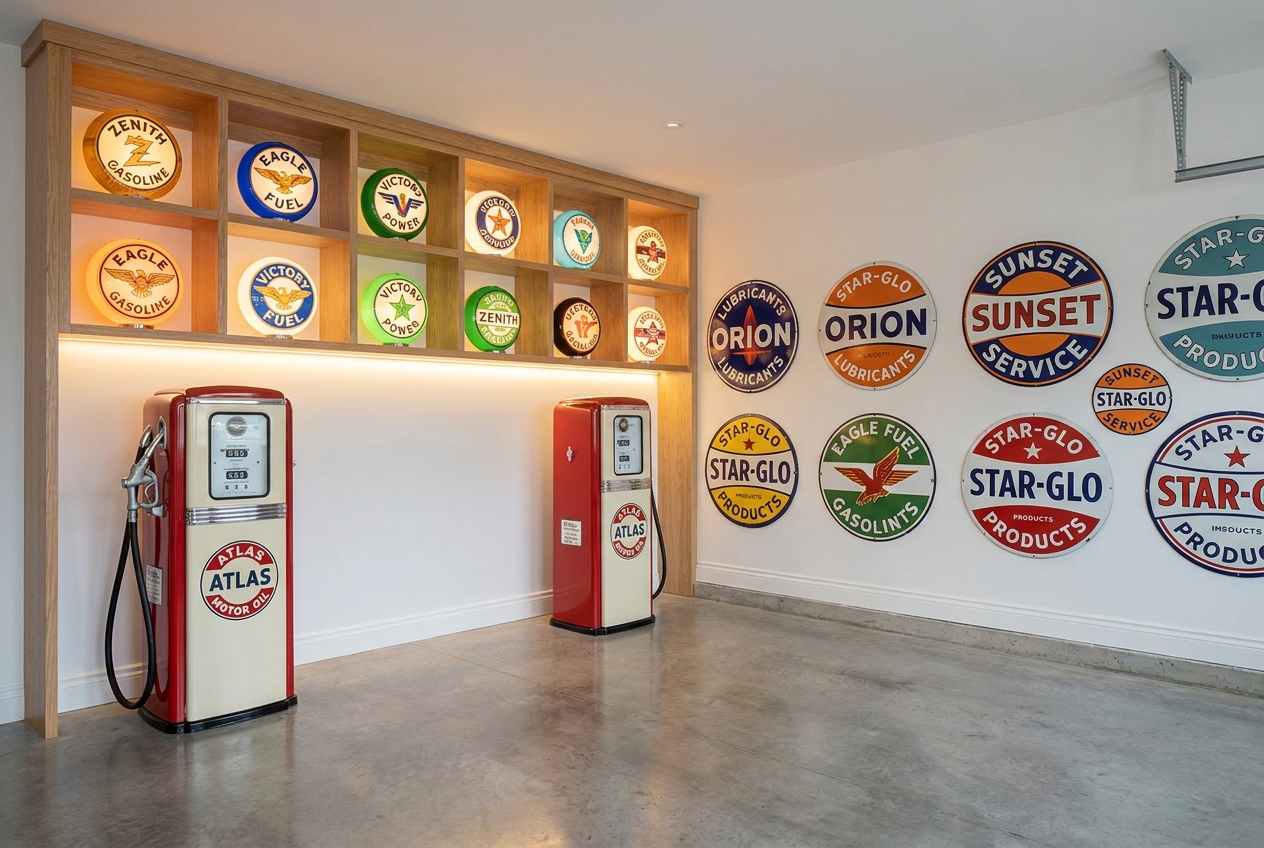
Most petroliana collectors assume the wall of porcelain signs in the garage and the restored visible pump in the den are "covered by the house policy." They technically are — for a fraction of what they're worth, under terms that quietly exclude the way collections actually get damaged. By the time a collector learns the difference, it's usually at claim time, which is the worst possible moment.
This guide walks through exactly where a homeowners policy falls short for petroliana and what proper coverage looks like.
Problem 1: Blanket Sub-Limits
Homeowners policies group "collectibles," "fine art," and similar property into categories with low blanket sub-limits — often just a few thousand dollars total. A single rare die-cut sign or a museum-grade pump can exceed the entire category limit on its own. Everything above that line is simply uninsured.
Problem 2: Actual Cash Value, Not Agreed Value
When a homeowners policy does pay, it typically pays actual cash value — replacement cost minus depreciation. For petroliana, that's a double problem:
- There's no Blue Book, so an adjuster is free to argue what a one-of-a-kind item was "really" worth.
- Depreciation makes no sense for appreciating collectibles, yet the policy form applies it anyway.
The result is a settlement that rarely reflects collector-market value.
Problem 3: Excluded Perils
The perils most likely to damage petroliana are the ones standard forms handle worst:
- Breakage of glass globes and porcelain enamel is often treated as excluded wear or simply not covered.
- Transit and off-premises losses — at a show, in storage, in the truck — fall outside a location-bound homeowners policy.
- Mysterious disappearance and theft of small, high-value smalls is sub-limited.
Problem 4: A Claim Hits Your Home Policy
File a collectibles claim on your homeowners policy and you risk a surcharge or non-renewal on the policy protecting your house — paying twice for one loss.
What Proper Coverage Looks Like
A specialty collectibles policy — usually written as an inland marine floater — fixes all four problems:
- Agreed value: you and the carrier set each item's value up front, paid in full after a covered loss, no depreciation.
- Scheduling and blanket limits: headline pieces scheduled individually, the broader collection blanketed.
- All-risk, including breakage: the fragile-item perils that matter to petroliana are covered.
- Off-premises and transit: coverage follows the collection to shows, storage, and on the road.
The Bottom Line
If your petroliana is worth more than a few thousand dollars, your homeowners policy is almost certainly not enough. Scheduling the collection on an agreed-value floater is inexpensive relative to the value it protects — and it's the difference between a smooth claim and a painful one. We'll help you inventory, value, and schedule your collection correctly. [Request a quote](/quote) or call us to talk it through.